Nursing

Healthcare


http://www.youtube.com/watch?v=Jng4TnKqy6A

Healthcare reform, the more I read about it the more complicated it seems. I came across this little video that gives a basic explanation. Simple enough, are the facts he includes true? Medicare uses 2-3%, private insurance uses 20%? Notice that he didn’t include education in the examples of essential government run socialized services. Why not? It has a government option for all, paid for by taxes, and a private option for those who choose to pay for it. Some question about how well it works, clearly many are educated well enough, some manage to get excellent educations and some end up falling through the cracks. It is not perfect, but it functions. Health insurance for all is not going to be perfect either, but hopefully it will function. And function well enough that not too many fall through the cracks and more people get what they need. I am about to become part of the public healthcare system as I begin my new job in the county ER, and I hope to provide care for everyone that walks through that door.

New grad ER nurse

I don’t know if I can call myself an ER nurse yet, but today at the end of my interview for an ER position the nurse manager said to me, “I am very impressed with everything you’ve done and what we talked about today. The August group of new hires is full, but we have room in the September group if you would like the position.” My ears did a double take, what! really?! You are willing to take a chance on me? wow, yes! It is a job in the ER in the hospital 6 blocks away from me. What could be better, my dream job! I am definitely doing the happy dance.

Restless

It has been over a month since graduation and I am no closer to landing a job. The current economy has not been good for us new grad nurses this year. Sure, there is a shortage of nurses, and people still need medical care, even in a bad economy. But, what is happening is the nurses that were expected to retire have not, and not only that, they have increased their hours since they need money too. The hospitals don’t want to spend the money to train new nurses when there are plenty of experienced nurses around so they are postponing their new grad training programs, and they don’t hire new grads without these programs. I keep hearing people talk about the baby boomer nurses hanging on to their jobs and I have to stop myself from getting irritated because after all I AM a baby boomer too, and I have no intention of retiring any time soon. Hey, I am just getting started!

I keep applying to jobs, first all over the Bay area and now all over California. I could wallpaper my room with all the rejections letters I have gotten. That is the hard part, I am having a difficult time not getting discouraged by all the rejection letters. I know there is a spot for me out there in a hospital somewhere, I just wish it would show itself soon, ’cause I am restless.

I keep trying to pass the time knitting or reading or doing some other thing that I used to enjoy, but I can’t seem to focus these days. I keep flitting from this project to that project and can hardly pull myself away from the computer waiting for a job posting to come in or a response from one of my applications to show up in my inbox.

I do have a few FO to show you though.
First, here is Olive’s sweater (the red one with the fake cables) I started it in the beginning of May see here. I gave it to my classmate, Trisha on the night of our pinning.

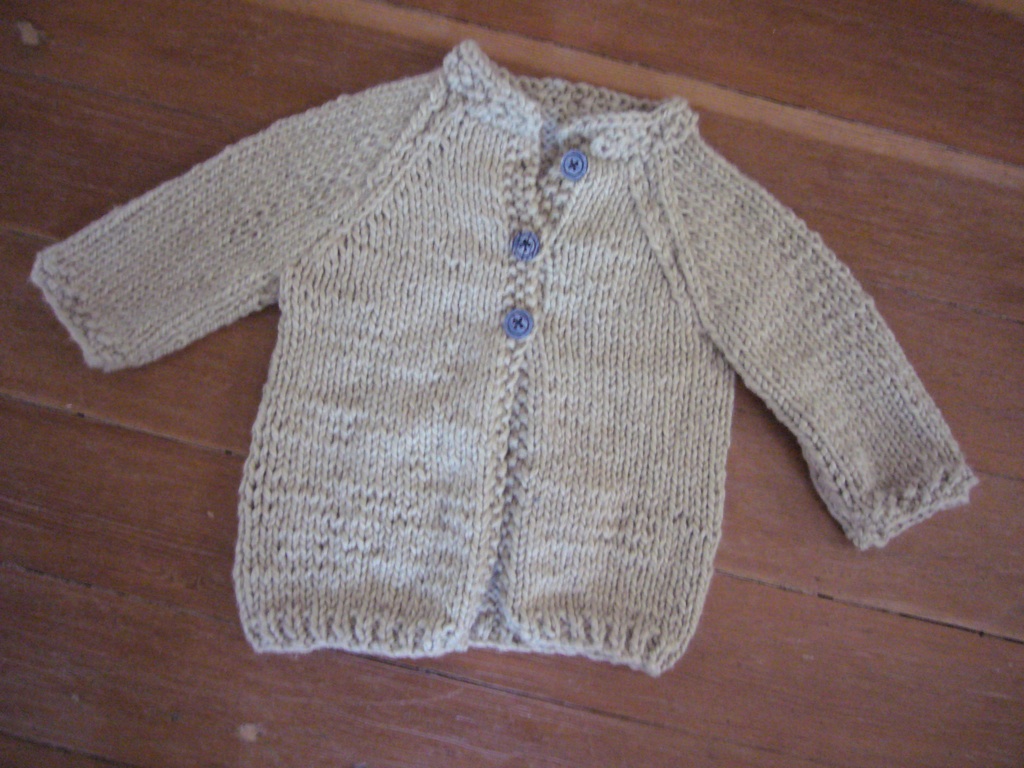
Then I started a sweater for one of Brian’s coworkers baby boy. This one is the same pattern as Erin’s sweater except that I had to adjust the guage because this yarn (Blue Sky Organic Cotton) is much thicker. I love knitting with this yarn, it is so incredible soft. I don’t care for the color much though. I had to rip out this sweater a few times because I failed to adjust the pattern for the thicker yarn, and then I got carried away and knit too many inches before I started the decreases for the raglan sleeves.
I finally finished it the morning I left for Tahoe to study for the NCLEX.

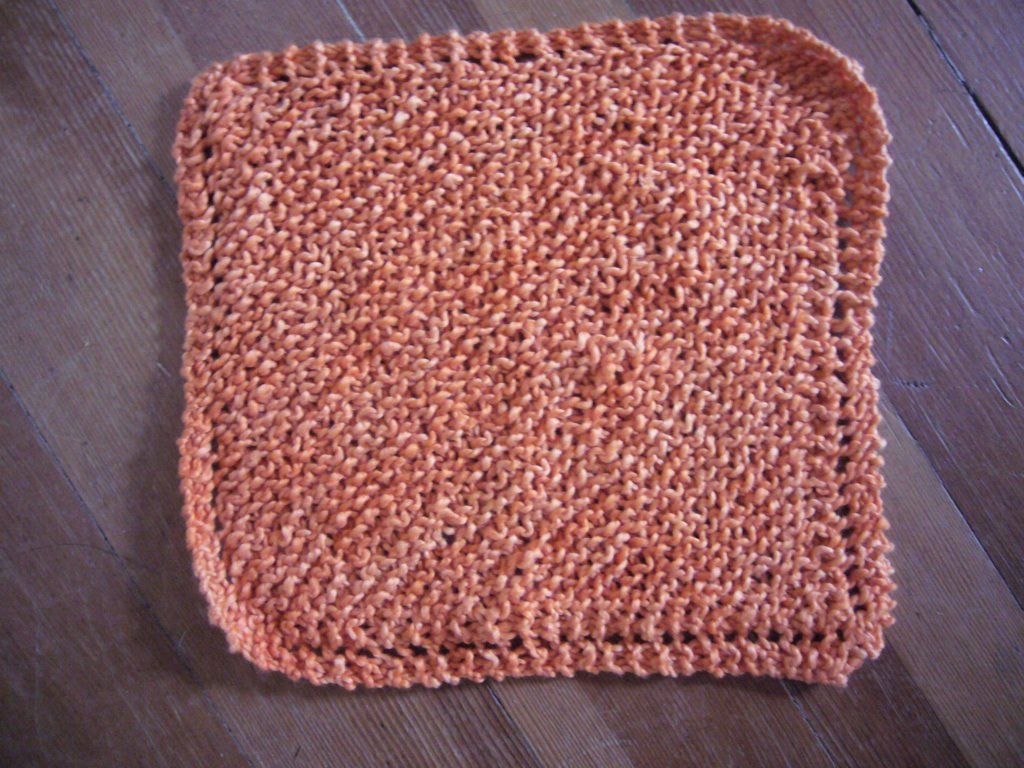
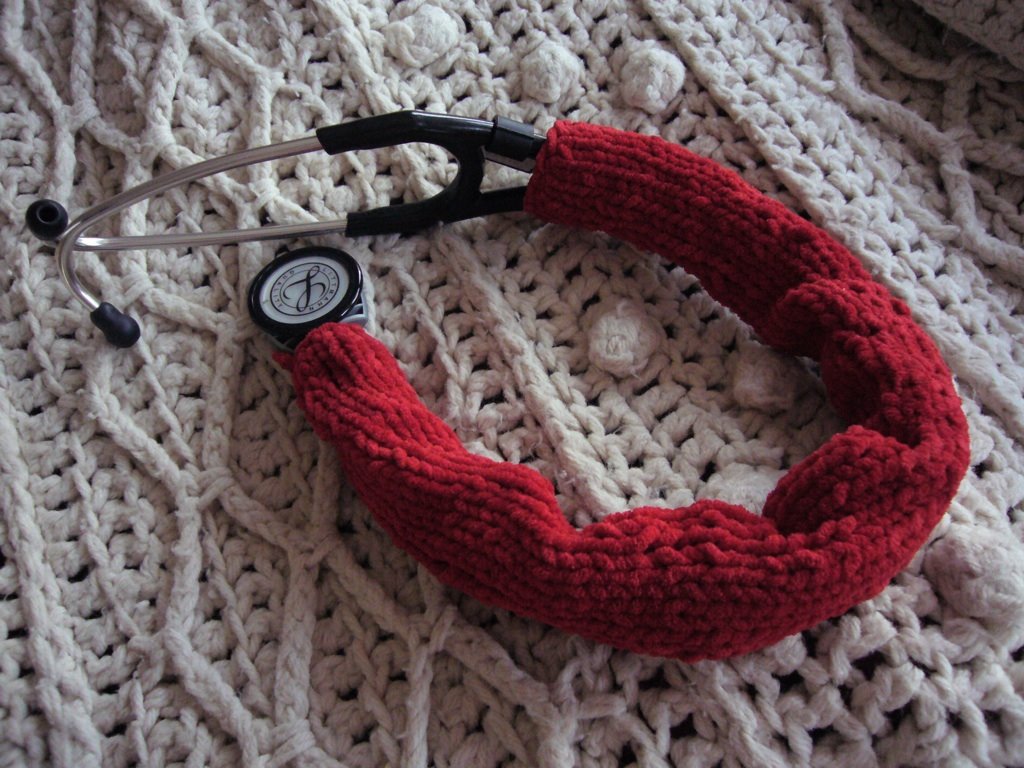
Since then, however I have not been able to concentrate on knitting, or anything else for that matter. So I have been making washcloths and stethoscope covers for my friends, just to keep my hands busy.

Last week, the day I found out that I passed the boards, I decided to uncover my loom and see if I could remember what to do. I had put a blanket over the loom for the entire year so it wouldn’t entice me away from my studying. I knew if I looked at it all the time, I would want to sit down and weave a few rows and knowing me, I wouldn’t tear myself away from it to get back to studying. So I covered it with a blanket and didn’t look at it. Well, when I looked at what I had done I couldn’t believe how beautiful and amazing it is! I had started making some kitchen towels, I think the warp is long enough for 4 towels, but to tell you the truth, I am not sure anymore. I looked at my notes and tried to remember enough to read the treadling pattern. After a good twenty minutes of staring at my notes and staring at the weaving, I figured out what I had been doing and started weaving again. Wow! I finished up the last few inches of the first towel, put in a divider and started the next towel. It will be more yellow than blue. I haven’t sat down to weave again. I am too restless, can’t sit still, can’t knit or weave. I sure hope this is temporary, I need these activities to keep me sane.

It’s official

I tell you, I have checked this site so many times since last Friday that when my name came up I thought it was someone else. But there it is in big bold official letters. I am a registered nurse. Sweet!

Waiting


For the last year ( two, if you count the prereqs) this has been my life, day and night. Some days I was sure someone glued me to the chair. Rose still asked everyday, “do you have studying, mom?” always hoping the answer might be no! I loved it though, I love school, (I know, I’m a nerd; the science was always my favorite part). I even liked taking tests, I like the feeling when I read a question and absolutely know the answer and can explain why, it is a powerful feeling. Then we got to work in the hospital with actual patients, and I was sure I was doing the right thing. I was scared out of my shoes that I wouldn’t know what to do, and often, I didn’t, but the patients always looked to me for help and comfort, and somehow I provided. I went from feeling like and impostor in white scrubs, grateful to be able to empty the bedpan; to gradually being able to manage 3 patients care by myself and having the sense that they are “my” patients by the end of my preceptorship.

Then we graduated a week before classes were over. We still had tests, and shifts, but we walked with our robes and hats and all. It felt great! That’s me in the middle of my new friends. Twenty nine years since my last graduation, this one meant so much, and I appreciated the opportunity so much more this time.

We did a few more presentations, and papers and exams, and then school really was over. We had our pinning ceremony, where we get pinned by another RN as a way of welcoming us into the profession. It was very touching, and we celebrated being done, finally!

Here is my pin, the initials are for Samuel Merritt University, we are the first class to graduate from the University, after 100 years of being a College. That is a lot of nurses! It is inspiring to come from such a long tradition, too bad we didn’t get the little white caps too!

BUT…. the studying wasn’t really over yet. I still had to take the board exam, the NCLEX. So my friend Marti and I kept meeting everyday to study for a couple of hours. We practiced thousands of questions, and quizzed each other, and looked up obscure drugs and diseases. We even spent a couple of days in Tahoe with two other classmates to study away from the distractions of house and family. We really did study, though nobody believes us. Then I spent a day in Yosemite, by myself, hiking and enjoying the scenery before I drove to Fresno to take my test.
I couldn’t have been more ready for this test, we studied all year, reviewed for several weeks, I relaxed for a whole day, got a good night’s sleep the night before, ate a healthy salmon (brain food) lunch and had a latte, and walked into the test center ready to conquer it.
It was the wierdest test I have ever taken. First, they take you one at a time, after you have been photographed, fingerprinted and pockets emptied into the test room. They don’t even let you take a tissue in there, I had to leave my bottle of water and my dark chocolates in a locker outside ( those of you who know me, I always have a couple of dark chocolates on my desk with me when I take a test, for that little boost when my brain wears out!). They sit you down in front of the computer and log you in and let you know that you are being video and audio taped during the test and if you need a break, raise your hand and the proctor will escort you to the bathroom. So, I sit down, a little unnerved by all the security, but ready to get this done. I speed through the little tutorial that takes you through some sample questions and push the button to start the real test. Now I should tell you that we have six hours to answer from 75-265 questions with breaks scheduled at 2 and 3.5 hours. The test is constantly evaluating how you answer each question to determine what the next question will be. It keeps asking questions until it determines that you clearly pass or clearly fail. I was determined to go slowly and carefully read each question a few times, since you can’t go back and change your answers. The first few questions were pretty reasonable and I felt pretty sure I was getting them right, then boom, they got hard, drugs I had never heard of, questions about priorities that I couldn’t rank, and then phwew, a few math questions. I love the math questions, because I know how to do them, they are concrete. It is the question about which patient you would see first that always gets me. Well, I am tooling along, I don’t really keep track of how many questions I am answering, (the last time I looked at the counter, I was on 55). The questions are hard, and I feel like I am guessing on many. I am sure I am not getting most of them right, so I am shocked when the whole computer screen goes black. Oh NO!, there is a power outage! right in the middle of my test! will I have to start over? But no the proctor comes in to escort me out and I realize that the screen went black because I was done! I quickly tell her this can’t be, I am not finished yet, I haven’t answered enough questions! there is no way I am up to 75 yet. Can she check? She smiles and shakes her head, no, there has not been a malfunction and there is no way for her to check the number of questions I answered. In a daze I walk out, put my finger on the fingerprint checker (what, was I going to somehow sneak someone else in to take my place while being videotaped? it is really me walking out now!) I collect my stuff, and see that only and hour and ten minutes have passed since my test started. Well maybe I started a little bit early, since I arrived at the center early, let’s say and hour and 15 minutes. Still that is 75 questions in 75 minutes, there is no way, I was going to go slowly! what happened? Oh no! what if I went so fast that I answered most of the questions wrong and I actually failed! I get in the car to drive the 3 hours home and try to think of who I can call that will make me feel better. Marti; she took the test the day before me and we hadn’t talked yet. Aachhh, I hear the sinking silence on the other end of the phone when I tell her that it took me 75 minutes, she took 2 and a half hours with 2 breaks. I didn’t even get a break. That is bad news, Marti is the speedy smart one. When we studied together she usually had the answer before me. I made some more phone calls looking for reassurance, which was given but I didn’t feel it. Nothing was going to make me feel relieved.

It has been 3 days now and I check the BRN website way to often to be considered sane, and still haven’t seen my name on the list of licensed RNs yet. I did the trick that someone said to try to register to retake the test and if the website won’t let you, then you passed. It wouldn’t let me, but I still don’t feel relieved. SO I AM STILL WAITING! I spent today listing all the hospitals that are within a one day drive of me and checking the job openings on their websites. The job hunt is another story that I will save for another post. In the meantime I am trying to keep busy and WAIT.

a good sign or a bad sign

Well, I took the NCLEX today and walked out of the test feeling pretty nervous. I think the computer shut down after 75 questions (the minimum), I am not sure because the last time I looked at the counter it said 55 and then all of a sudden it shut down. The questions were hard, so either I answered well enough that it moved me to the harder questions and I passed or….. I don’t even want to go there. Now I will keep checking the BRN site to see if my name pops up under RN verification. Next, renewed efforts to land a job in this economy.

following my patient through surgery

Wow, today was amazing.  I have a patient that has many issues, recovering from a major abdominal surgery on two weeks ago, and suddenly needed neck surgery.  Somehow the planets lined up just right for me and I was allowed to observe his surgery.  I went with him to pre-op and observed how they handle patients getting ready for surgery. He did not want to cooperate though, he refused the TED hose and didn’t want the intermittent leg inflation machine either both are used to help prevent blood clots from forming in his legs.  He answered all the OR nurse’s history questions though and was consistent in denying his diabetes even though he is on glucose monitoring and insulin injections.   Then I followed the OR nurse like a puppy into the locker room, donned surgical scrubs, booties and cap.  We went into the OR to prepare the room.  I met the anesthesiologist and the OR tech.  Watched them get the sterile field ready, get the gurney set up, count all the sponges, sutures, an other things.  Then I helped wheel my patient into the OR and transfer him to the table.  Since he is obese, this took several of us plus the lift team.  The surgeon came in and the anesthesiologist put him under. They sedated him first, then paralyzed his muscles then intubated him and put him on a ventilator. Everything is monitored, breathing, brain function, heart, blood pressure, temp.  They make sure there will be no breakthrough awareness. Once he was under they put that intermittent leg inflating machine on and arranged his limbs and tilted his head to expose his neck.  The OR nurse cleaned the area with betadine and the surgeon draped him with sterile drapes leaving only the front of his neck exposed.  The anesthesiologist sat at the patient’s head and watched a bank of monitors and adjusted medications.  He could see the patients face under all the drapes but unless he stood up, he could not see the surgery.  I was allowed to stand at arms length from the patient and watch, they explained some things that they were doing, the nurse was very good about telling me what the steps were and what they were watching for and concerned about.  The surgeon pointed out the thyroid and parathyroid as she was going, and called me to step closer to get a good look.  I felt very privileged to be there and didn’t interrupt with many questions.  As she started to cut (after carefully marking his skin) and cauterize the vessels, the OR tech kept handing her instruments and using suction and sponges to mop up the blood and fluid.  He seemed to know what she needed, the surgeon did not have to ask for much.  There was an assistant surgeon that came in to help after the thyroid was exposed.  The OR nurse spent most of the time during the surgery charting at the computer what was going on and getting things like the clean bucket for waste, and step stool for the other surgeon.  They found the mass on my patients parathyroid and were able to excise it from the thyroid pretty cleanly.  The parathyroid and the mass was huge, the pathologist commented that it was the biggest he has seen.  He took it away to analyze it to make sure it was parathyroid tissue that was removed.  Then they had to obtain a blood sample within 10 minutes of removal of the parathyroid to check the PTH level.  That was a challenge.  I got to hold the sheet up for the anesthesiologist to get in to use a foot vein to obtain a sample, while the surgeon tried to get a sample from one of the neck veins in the open part of the neck.  Neither one produced enough blood for the sample, finally the surgeon dug around to get at the internal jugular vein and was able to get plenty.  That got sent off to the lab STAT and they started to close him up after the pathologist confirmed that the tissue was indeed parathyroid tissue.  The assistant surgeon left at this point and the surgeon sewed the subQ tissue first and then the outer skin.  They chatted about their own lives at this point, they no longer had to focus so much on the surgery.  Then they counted everything, on the table and  in the wastebasket to make sure nothing was left in the patient.  After they removed the drapes the OR nurse came over and help the anesthesiologist rouse him.  I guess that once you stop administering the anesthesia, it wears off pretty quickly, although the nurse said he would have no memory of this time period.  My patient was slow to arouse however. He did not respond to commands or seem able to breathe on his own.  He could initiate his breaths but did not take in a deep enough breath to oxygenate his body.  They have criteria the patient has to meet in order to remove the trach tube, one of them is ability to follow commands, and the other is the strength to squeeze the doc’s hands and lift his head up for 5-10 sec. My patient could do neither.  They were also concerned about his blood pressure which was dropping pretty low.  Finally the anesthesiologist decided he should remain on the ventilator in the recovery room until he could breathe better on his own.  So we waited till they got all that equipment ready for him in the recovery room (PACU as it is called at this hospital)  The nurse was pointing out to me that it is much safer for the patient to remain in the OR while on the vent until they were ready because he could crash at any time.  They were all pretty calm considering what seemed to me pretty dire situation for my patient.  When they were ready we wheeled him into the recovery room and a new crew of people swarmed around to work on him.  The respiratory therapist was there to work the ventilator, the anesthesiologist stayed, the recovery nurse started her assessment with the help of a couple of other RNs.  This is where I felt in the way. I didn’t really know what to do and there was a lot of activity right away all around him.  The RT was watching the ventilator to see how deeply my patient was breathing, to determine when they might remove the tube.  The surgeon came in to check on him and examined the wound from his previous surgery (done by another surgeon)  and ended up cleaning it, culturing it and repacking it with gauze.  I watched all this pretty carefully.  Meanwhile the patient was coming around a little more and was agitated about the pain in his abdomen and the tube in his throat.  He wanted it out.  The nurse wanted to give him some pain meds but the anesthesiologist (who was still sitting there) didn’t want him to have any since it would affect his breathing.  But the patient was in pain and agitated so he let him have some, and it helped immediately.  He wanted the tube out though. They drew a blood sample for arterial blood gas test, the RT did this, I understand nurses don’t usually do this procedure.  I got to watch that too, but I couldn’t really tell how you know you are drawing from an artery and not a vein.  He use the patient’s wrist.  The anesthesiologist decided his breathing was getting stronger, (an hour in recovery) and he could be extubated if they put him on the BiPAP machine.  It is a machine that delivers positive pressure to the lungs on inhalation and also a lower pressure on exhalation but through a mask instead of a tube.  However my patient got very upset about this, and waved the machine away as they were bringing it to his bedside. He didn’t want this machine.  The anesthesiologist then decided not to extubate him then.  He just didn’t trust that the patient would be able to maintain his airway and reintubating him after neck surgery would be extremely difficult.  So they ordered an ICU bed for him.  At that point I had to go back to the floor since he would be going to a different unit and I would no longer be able to follow him.  All in all it was a very exiting day for me, although quite a difficult time for my patient.  I wish I could follow up on him to see how he does after a night in ICU.  The report that his PTH levels were decreased was good news but it will be a few days before we hear if the mass was cancerous or not.  I was relieved that I was able to watch the procedures without getting grossed out, or fainting or even feeling sick.  You never know how you will react until you are actually in the situation and I am glad I did fine.  It was actually really fun.  I wonder if I might like working in surgery, who knows.

Tomorrow I have a new patient.  A very young stroke patient just admitted this afternoon.

Study Break or prevention of pressure ulcers

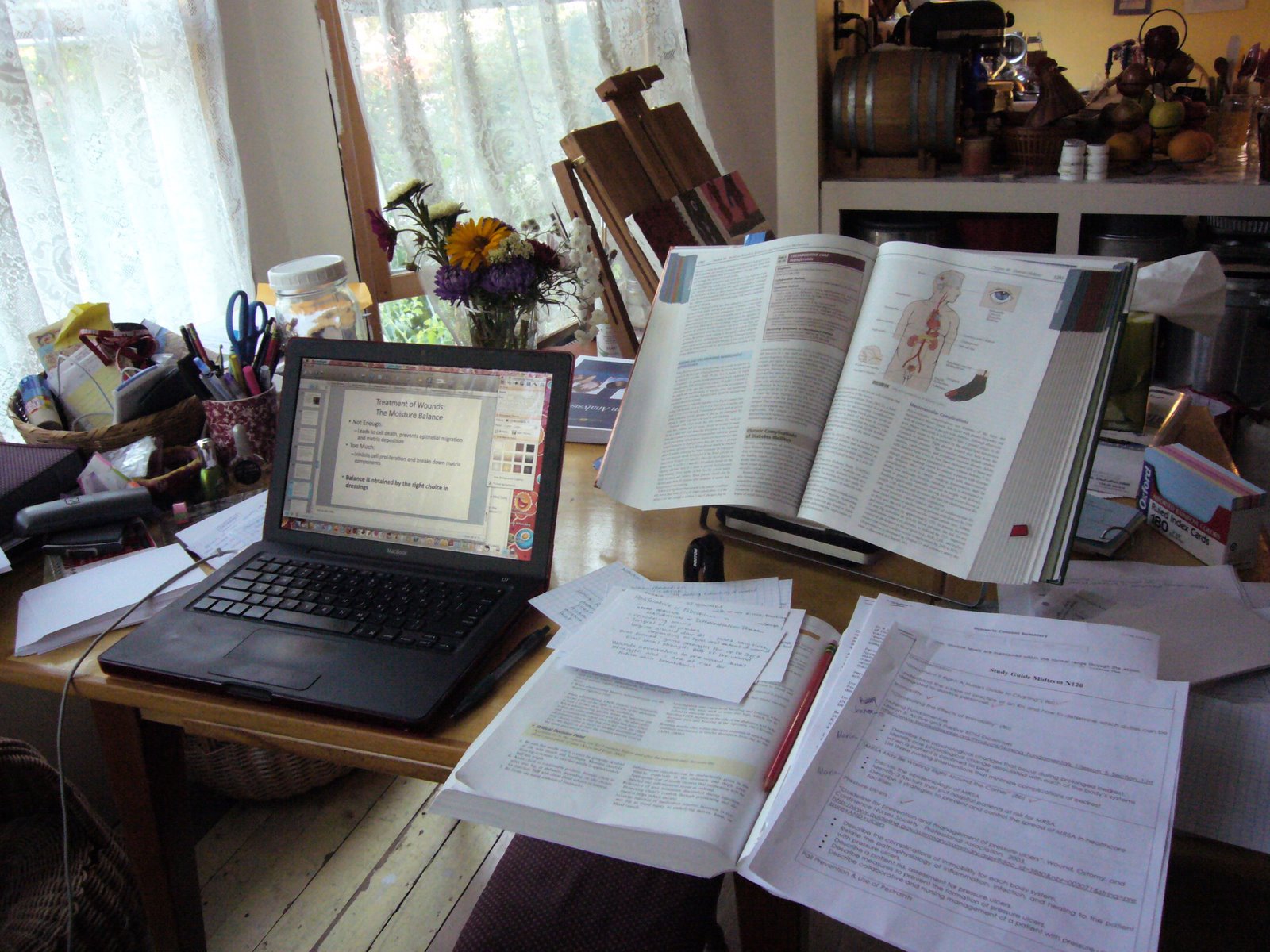
I have been studying all weekend for a test Monday and another one Tuesday. However I did take many breaks.  Yesterday I spent a couple of hours communing with my roses.  They have been quite neglected these last couple of months but they are still producing abundant blooms and making hips like crazy.  I pruned and deadheaded them, got them back into shape.  I got to see how well some of the new bushes we put in last season are really taking off this year, and that there are a couple of bushes that are still looking weak and spindly in spite of the good pruning they got in February.  They may need to go, and make room for some new ones this fall.  One thing about gardening is that you have to be ruthless sometimes, if it doesn’t produce and look good with the level of care I can provide, it gets pulled out and replaced.  I do give them a good long time to come around and produce, but I can’t wait forever.  I took a nice long study break today to wander around the garden and harvest some flowers to brighten up the inside of the house.  Brian has spent a lot of effort this year to grow some of these from seed for our butterfly patch and cutting garden.  When I spend hours in front of the computer and under two gigantic textbooks (each one is 2000 pages) I need to get up and walk around in the fresh air and breathe in the fragrance of flowers.  I picked a whole basket of asters, cosmos, hydrangeas and others that I don’t know the names of and arranged them in vases to set around the house.  I put one on my study table too, so I just need to glance up from my computer screen and see the explosion of color.

We have a big test tomorrow in Managing Care of Adults.  It covers wound care, diabetes, seizures, eye and ear diseases, problems with immobility, and the nursing process.  It really is a huge amount of material.  As I  read about pressure ulcers and look at the slides of how they look at various stages, I beg
in to squirm in my chair and wonder how long it takes for one to form if I am immobilized in front of my books.  I feel my ischial tuberosity press on the thin little pillow on the chair and I quickly leap up and make sure I don’t have any red non-blanching areas forming on my skin!  I also have been so attached to my computer; taking notes, doing online tutorials and quizzes, trading questions and tips with my study group that I dream of having an IV pole with my computer on it to drag around with me wherever I go.  It has become a lifeline feeding me facts, testing my knowledge, and allowing me to reach out to my new friends.  We also have a lab practical on Tuesday; a head to toe assessment in 30 minutes.  I’ll practice that after tomorrows test.
This week we were in the hospital for our clinical rotation taking care of our first patient. My first patient was a very sweet man with cellulitis of the right leg. We spent the first day shadowing the nurse, learning where supplies are, how the medication cart works, what the routine for the day is.  We got our patient and researched all their medications, and their diagnosis.  Then the next day we did the assessment on them, I gave mine a bed bath and changed his bed, gave him his subQ heparin injection, hung some IV’s, counted his I & O’s and spent lots of time talking to him about his family and history.  I also got to observe the placement of a foley catheter on one patient and do the removal of one on another patient!  Wow, a lot of new things for the first couple of days.  I learned a lot just listening to the nurses and watching them deal with the problems that came up. And there were many. We never stopped, and it was hard to take time for lunch except that I was starving!  I loved the whole process.  The patients were willing to have us students work with them and mine even asked if he could come to my graduation! I can see that this is where the major portion of our learning will take place.  It is exciting to see the things we are learning about in the books, right in front of us.  The whole nursing process is beginning to make sense, constant assessment of the patient and trying to come up with ways to make them comfortable at the same time providing what they need for their healing.  I am going to like this job!
Well, back to the books, a little more review before bed.

Both sides of the Needle

Back to nursing.  We are in our second term of classes now, Health Assessment II and Managing Care of Adults as well as starting  our clinical experience.  Now we are in class from 8:30-7:15 on Mondays and Tuesdays and in clinicals Wednesday through Friday from 7-4.  It is a long week and we are flying through material. Next week we are being tested on giving a full head to toe physical exam on our lab partner which we have to get done in 30 minutes without notes! starting with the scalp, eyes, ears, nose, mouth, testing all the cranial nerves, respiratory, cardiac, peripheral vascular, muscles and joints, abdomen, extremities and spine.  There are lots of specific things we need to look for and note.  We do all of these skills on each other so we get to experience the patient viewpoint too.  Today we learned about administering medications, including injections!  We gave injections to each other in our abdomens and hip muscles. Just normal saline, not real medication and we all did amazingly well.  I have to say it is harder than it looks. Holding the needle above my lab partners hip as I placed my hands on her landmark bones to determine where the muscle was to inject into made me a bit nervous about making a mistake and hurting her.  I could hit a blood vessel or a nerve or bone! and she was watching! Along with the instructor and the rest of the class!  But I didn’t hurt her, I found the muscle, injected the saline, drew out the needle and she was fine.   Then it was my turn to be injected.  I am not usually squeamish about injections, they don’t really scare me.  But lying in the hospital bed as my partner prepared the syringes and asked questions of the instructor, I began to feel kind of vulnerable.  I have never had an injection in my abdomen before and I was worried that it would be very painful (in the stomach we did sub-Q injections) and I am pretty ticklish and don’t like people touching my belly so it took a lot of effort to stay calm with all my classmates watching while she did the injection.  It didn’t hurt at all! Same with the IM injection in the hip. No problem.  It was a good experience for us to have with each other.  We learned about how patients may be feeling vulnerable, apprehensive and scared, as well as the physical discomfort of being ill. We are all focused and excited about gaining new skills. We must remember that we are caring for a human patient and not just finding hips to test our injection skills.  There is a lot we need to learn in terms of gaining confidence in the physical skills and also in learning sensitivity and compassion for our patients.  Tomorrow we go to the hospital to get our first patient and shadow the nurse and start practicing some of our newly learned skills. Mostly beds and baths at first I think.  I think our experience today of being on both sides of the needle has given all of us a little perspective.